PhD
Social Science
Scientific Papers Are Getting Harder to Read and It’s Not Just You

Written By
Javanshir Huseynzade
Jan 13, 2026
Scientific papers are becoming harder to read according to a 2017 eLife study. Discover why academic writing is declining in readability and how using clear language can speed up scientific progress and inclusion.
Imagine you find a dusty journal article from the late 1800s. You expect old timey language, maybe a few dramatic flourishes, or perhaps a sentence that politely tips its hat. You start reading and realize it is surprisingly understandable. Then you open a modern paper from your field and immediately feel your soul leave your body through your left ear.
That feeling is not a personal failure. It is a measurable trend.
The Data Behind the Confusion
In 2017, Plavén-Sigray, Matheson, Schiffler, and Thompson published a paper in eLife with a simple idea. They wanted to measure whether scientific writing has become harder to read over time.
Spoiler: it has.
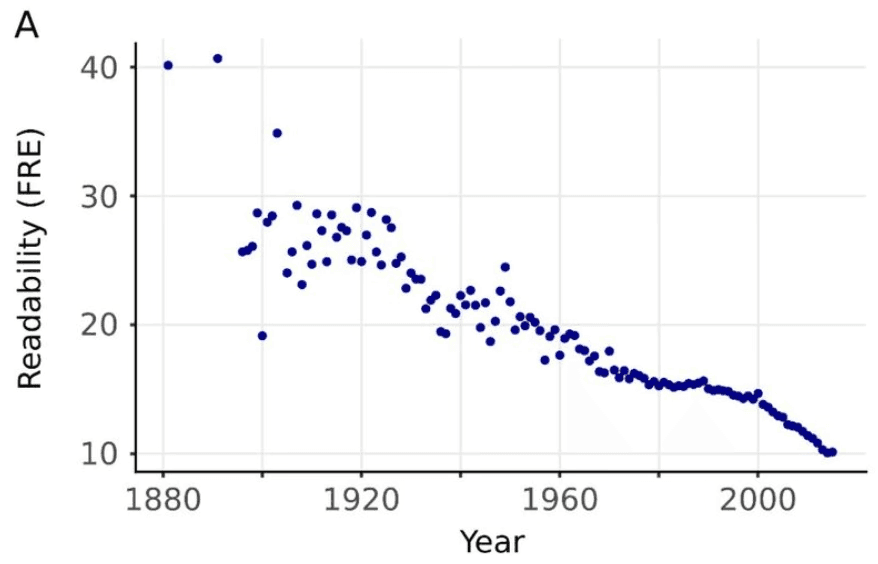
The authors analyzed a huge collection of scientific text over many decades and tracked readability using standard formulas. One of the primary metrics was Flesch Reading Ease. This formula turns sentence length and word complexity into a score. Higher numbers mean easier reading while lower numbers mean your brain starts negotiating an exit plan.
When they plotted readability over time, the pattern was not subtle. The scores drift downward across the decades, meaning scientific writing has steadily become more difficult to process.
Even if you do not care about the math, the direction is clear. The trend line is doing the literary version of a slow, sad slide downhill. As seen in the figure below, early years cluster at higher readability scores. By the modern era, the points hang out in territory where paragraphs are technically English but also feel like a curse.
Why Are We Writing Like This?
There is no single villain twirling a mustache in the shadows of academia, whispering "add more nominalizations". It is likely a bunch of forces piling up over time.
Specialization: As science progressed, vocabulary naturally became more specialized. When you are naming molecules or mechanisms, you either invent precise terms or you write three sentences every time you want to say one thing. Precision is valuable, but it comes with a readability tax.
Signaling: There is a culture of academic signaling. Many writers, especially early in their careers, internalize the idea that sounding complex equals being serious. However, complexity in ideas does not require complexity in sentences. We do not have to cosplay as fog.
Publishing Incentives: Modern papers are packed with more detail, citations, and careful hedging. Caution is good science. But when every sentence is wrapped in bubble wrap, your reader has to unwrap the meaning before they can use it.
Put all that together and you get a world where writing becomes less like a clear window and more like an escape room.
Does Readability Actually Matter?
It matters more than we like to admit because unreadable science does not just annoy people. It slows everything down.
If a paper is difficult to parse, fewer people fully understand it. That can mean fewer useful citations, more misunderstandings, and more mistakes in replication.
Readability also affects inclusion. Scientists are global, and many brilliant researchers read in a second or third language. When writing becomes denser and more jargon-heavy, it raises the barrier to entry. In a world that already has too many barriers, adding another one because we refuse to use shorter sentences is not the best look.
The Small Rebellion: Writing for Clarity
If you are writing papers, blog posts, or grant proposals, there is a gentle kind of rebellion available to you. That rebellion is clarity.
Clarity is not dumbing down. Clarity is respecting your reader’s working memory.
Use Verbs: Let verbs do their job instead of turning everything into nouns.
Simplify Structure: Use fewer stacked clauses and define jargon once before moving on.
Own the Action: Remember that "we found" is often better than "it was observed that".
Funny enough, clear writing is usually harder for the writer. It forces you to understand what you mean before you ask someone else to understand it. Dense writing can hide confusion, but clear writing exposes it. That is uncomfortable, but scientifically healthy.
Plavén-Sigray and colleagues basically held up a mirror to the scientific community. That alone is useful. It gives us permission to stop gaslighting ourselves and start treating clarity as part of rigor rather than the enemy of it.
Science is already hard. Reading it should not feel like an additional experiment in endurance.
Newsletter
Enjoyed this read? Subscribe.
Get practical research tips, interview templates, and Askiva updates straight to your inbox.
Unsubscribe at any time
Written By
Javanshir Huseynzade
Updated on
Jan 13, 2026